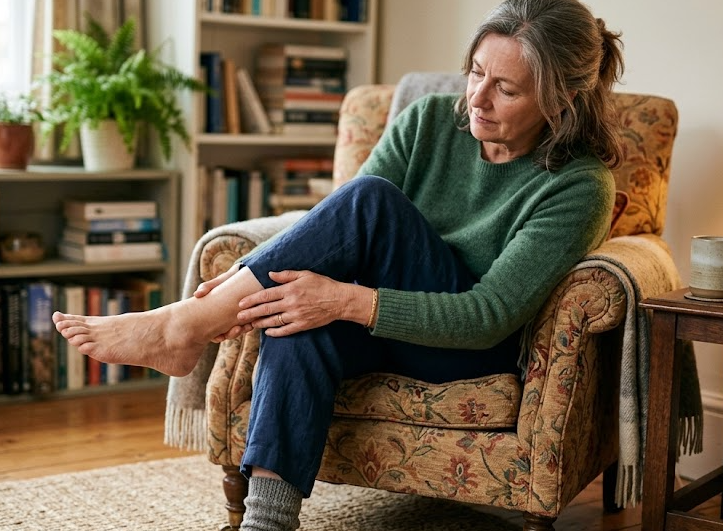
1. The Biological Reality: What Changes in Our Feet?
If you are over the age of 40 and struggling with plantar fasciitis, you have likely noticed a frustrating reality: injuries that used to heal in a matter of weeks now seem to linger for months, or even years. You are not imagining this, and it is not your fault.
When we are in our 20s and 30s, our connective tissues are highly resilient. A minor strain in the foot arch heals rapidly because cellular turnover is incredibly high. But as we cross into our 40s and beyond, fundamental physiological shifts occur within our body's structure.
According to the American Podiatric Medical Association (APMA), by the time we reach 50, our feet have lost roughly half of their natural shock-absorbing capability. The mechanics of your stride change, the cellular composition of your tendons alters, and the standard "cookie-cutter" treatments you find online stop working. To successfully cure plantar fasciitis after 40, we must first understand exactly *why* the healing process has slowed down.
2. The Role of Collagen and Tissue Elasticity
The plantar fascia is a thick, web-like band of connective tissue made almost entirely of collagen. Collagen is the structural protein that gives your tendons and ligaments their incredible tensile strength.
However, multiple clinical studies published by the NIH confirm that as we age, the rate at which our body produces new collagen significantly drops. Furthermore, the *type* of collagen in our tendons changes.
- In our youth: The plantar fascia is dominated by Type I collagen, which is highly elastic, organized, and structurally robust.
- After 40: The body begins replacing micro-tears with Type III collagen, which is more haphazard, stiffer, and less flexible.
This decrease in elasticity is the primary reason why the "first step" out of bed in the morning becomes so agonizing. When the stiffened fascia attempts to stretch under your body weight, it cannot yield as easily as it once did. Instead of stretching smoothly, it tears. Because your cellular turnover is slower, these micro-tears compound daily, leading to chronic, unyielding inflammation.
3. Weight Distribution and Plantar Fat Pad Atrophy
Beneath your heel bone (the calcaneus) lies a thick, specialized layer of adipose tissue known as the plantar fat pad. This pad serves as nature's shock absorber. Every time your heel strikes the ground, this fat pad squishes and disperses the kinetic energy, protecting the bone and the insertion point of the plantar fascia.
Unfortunately, fat pad atrophy is a universal symptom of aging. As we pass 40, this cushioning naturally thins out and loses its bounce.
"When the heel cushion thins, the kinetic impact of walking is transferred directly into the plantar fascia attachment site. It’s the equivalent of taking the suspension out of a car and driving it over a bumpy road."
This lack of natural cushioning means that barefoot walking on hard surfaces—like hardwood floors or kitchen tiles—becomes exponentially more damaging as we age. The trauma delivered directly to the fascia creates localized inflammation that your slower-healing body struggles to clear.
4. Decreased Blood Flow to the Fascia
Healing requires oxygen, nutrients, and immune cells. These are delivered to injured tissues via the bloodstream.
The plantar fascia is notoriously slow to heal because, even in youth, it is poorly vascularized (meaning it lacks a robust blood supply). As we age, our circulatory system becomes slightly less efficient. Capillary density in our extremities decreases.
When the plantar fascia sustains a micro-tear, it relies on this already-weakened blood supply to deliver the building blocks of repair. This reduced vascularity is why "rest alone" rarely cures plantar fasciitis in adults over 40. The tissue simply cannot get enough blood flow while sedentary to heal itself. It requires active, gentle mobilization to pump blood into the area without re-tearing the fibers.
5. Menopause, Hormones, and Heel Pain
For women in their late 40s and 50s, hormonal shifts play a massive, often-ignored role in tendon and fascia health. Estrogen has a profound protective effect on connective tissues.
As estrogen levels decline during perimenopause and menopause, collagen synthesis is further impaired. Tendons and fascia become drier, stiffer, and more susceptible to injury. According to the Mayo Clinic, women in this age bracket represent one of the highest-risk demographics for developing chronic plantar fasciitis.
Understanding this hormonal link is vital because it explains why pain can suddenly appear even if your activity levels haven't changed. It requires a shift from aggressive rehabilitation toward gentle, sustained capacity-building.
6. Why Standard Stretches Fail "Experienced" Feet
If you search YouTube for "Plantar Fasciitis Stretches," you will find thousands of videos demonstrating aggressive calf stretches, stair drops, and toe pulls.
While these protocols work wonders for a 25-year-old athlete, they can be disastrous for a 50-year-old recovering from chronic heel pain.
The Danger of Aggressive Stretching
When tissue elasticity is already compromised, forcing the foot into an extreme, deep stretch triggers a defensive reflex. The muscles spasm to protect the joint, and the rigid fascia is pulled past its breaking point, creating fresh micro-tears. You effectively reset the healing clock to zero.
Furthermore, older adults often have secondary joint issues—perhaps mild arthritis in the knees or stiffness in the hips. Aggressive, unbalanced stretching protocols can aggravate these secondary joints, trading heel pain for knee pain.
7. The Solution: Adapting Your Recovery Plan
Healing after 40 is absolutely possible—and highly probable—if you stop treating your feet like they are 20 years old. You must adapt your approach to respect your body's current physiological reality. Here are the three non-negotiable pillars of recovery for experienced feet:
A. Extended, Zero-Impact Warm-Ups
Because your fascia is stiffer and blood flow is reduced, you cannot immediately transition from sleeping to walking, or even from sleeping to deep stretching. You must implement a "transitional phase."
Before you ever step out of bed, spend 3 to 5 minutes performing non-weight-bearing mobility exercises. Simple ankle circles (drawing the alphabet with your big toe) and gentle, manual massage of the arch will stimulate synovial fluid and draw blood into the fascia. You must "thaw" the tissue before you stretch it.
B. Joint-Friendly Capacity Building
Instead of aggressively forcing the fascia to stretch, you must focus on "eccentric loading"—a physical therapy concept where the tissue is lengthened slowly under tension. This encourages the disorganized Type III collagen to remodel into strong, linear Type I collagen.
In our specialized 40+ Edition Recovery Plan, we focus on modified, seated stretches and supported wall leans that protect the knees and lower back while safely delivering the necessary mechanical load to the foot.
C. Uncompromising Arch Support
To combat fat pad atrophyfat pad atrophy and protect the healing tissue, you must become militant about your footwear.
- Never walk barefoot on hard surfaces, not even for a midnight trip to the bathroom.
- Wear supportive, structured house shoes or recovery slides indoors.
- Ensure your outdoor footwear has a firm heel counter and a rigid midsole that prevents the arch from collapsing during the gait cycle.
8. Final Thoughts: Healing is Possible at Any Age
Age is not a life sentence to chronic pain. The slowing down of our cellular repair processes is a biological fact, but it is a hurdle, not a wall.
When you shift your mindset away from "quick fixes" and aggressive manipulation, and move toward a structured, patient, and joint-friendly routine, the plantar fascia will heal. By respecting your body's changing elasticity, supporting your thinned fat pads with proper footwear, and applying targeted, gentle rehabilitation, you can conquer morning heel pain and get your life back.
Ready to start your recovery?
Don't try to build a routine from scratch. We have done the clinical research for you. Check out our comprehensive 40+ Edition Plan in the sidebar to get a day-by-day roadmap tailored specifically for experienced feet.